


castles south france
A mosaic of fortresses and palaces between sea, scrubland, and mountains
From the Mediterranean coast to the foothills of the Pyrenees, the south of France unfolds an incredible diversity of castles. Here, a rocky promontory overlooks an ochre village; there, a citadel watches over a dizzying gorge; further on, a Renaissance residence leans against vineyards and olive groves. Each stone seems to have kept the memory of trade routes, feudal rivalries, crusades, religious wars, and then the southern art of living made of light, gardens, and terraces. This journey offers a selection of the most remarkable sites — some world-renowned, others more confidential — with concrete advice to make the most of them, without rushing, taking the time to understand what each castle tells about the territory that surrounds it.
Château des Baux-de-Provence (Bouches-du-Rhône): the mineral fortress of the Alpilles
Perched on a limestone spur, the Château des Baux-de-Provence is one of the most striking backdrops in Provence. It is not a palace in the classical sense, but a spectacular defensive ensemble, almost fused into the rock. The visit is an immersion into the world of the lords of Baux, a great medieval lineage whose power radiated far beyond the Alpilles. The remains — towers, ramparts, halls carved from stone — take on a particular relief when the mistral sweeps across the plateau and clears the view of the olive groves, plains, and, in the distance, the bluish reliefs.
To savor the place, prefer the early morning: the light glides over the cliffs and the foot traffic is lighter. Also take the time to wander through the village, whose steep alleys, old houses, and viewpoints naturally extend the visit. The interest of the site lies as much in its perspectives as in its history: one understands why a fortress here was a tool of power as well as a symbol.
Château de Tarascon (Bouches-du-Rhône): power on the Rhône and Gothic elegance
Massive, almost intimidating, the Château de Tarascon is a demonstration of strength perched on the banks of the Rhône. Built in the 15th century for the house of Anjou, it combines military character (high walls, imposing towers) with a search for ornamentation typical of princely residences. Inside, the circulation between courtyards, halls, and staircases reveals the organization of a large late castle, designed to defend but also to represent.
What strikes is the contrast between the austere exterior and some more refined spaces: worked openings, more residential volumes, details that betray an ambition for prestige. The Rhône, meanwhile, is not just a backdrop: it explains the location, strategies, and economy. A visit here is also understood as a chapter in the history of exchanges and southern borders.
Forteresse de Salses (Pyrénées-Orientales): military architecture in its purest form
At the junction between two worlds, the Forteresse de Salses was designed to hold, and it shows. This is not the romantic castle with gardens, but a defensive machine: embankments, thick walls, firing devices, rational organization of spaces. The stone, sand, and sky of Roussillon give the site an austere and fascinating, almost geometric tone.
Need a room? Book directly!
The visit takes on a particular dimension if one is interested in the evolution of artillery: Salses tells the moment when castles had to adapt to cannons. One physically feels the idea of impregnable: narrow corridors, checkpoints, protected inner courtyards. It is an ideal place to understand how technique transforms architecture and, with it, the balance of power.
Château de Peyrepertuse (Aude): Cathar vertigo and ridge lines
Clinging to a rocky ridge, Peyrepertuse offers one of the most spectacular silhouettes in Occitanie. The access path already prepares for the experience: one climbs, one distances oneself from the world, and the castle reveals itself as an extension of the mountain. Here, beauty arises from the dialogue between built stone and natural stone, between human effort and the harshness of the relief.
The reward is twofold: first, immense panoramas over the Corbières; then, the rare sensation of walking a site where architecture merges with the landscape. Plan for good shoes and, if possible, avoid the hottest hours: shade is rare, and the southern sun makes walking demanding. Peyrepertuse is earned, but that is precisely what makes it unforgettable.
Cité de Carcassonne (Aude): the mythical fortress with endless ramparts
Carcassonne is an obvious choice, but it remains essential: it is one of the most impressive medieval ensembles in Europe. Its double ramparts, towers, fortified gates, and count's castle compose a grand scene. Even though the site is heavily visited, it retains an exceptional evocative power, especially when one distances from the main arteries to find a quieter angle, a fragment of wall, an escape onto the roofs.
To enjoy it better, spread out the visit: a first part dedicated to the ramparts (to feel the defensive logic and measure the scale), then a second to the count's castle (to enter the heart of power). And if you can, stay until evening: when the light fades, the stones take on a warm hue, and the atmosphere becomes, at times, almost timeless.
Château de Grignan (Drôme): Renaissance majesty above the Provençal Drôme
In the Provençal Drôme, Grignan stands out with its appearance of a grand aristocratic residence. It dominates the village and the landscapes of lavender, oaks, and vineyards, with an elegance that comes as much from the volumes as from the position. Here, one leaves the image of the rugged fortress to enter that of a representative castle: orderly facades, courtyards, staircases, rooms that tell the evolution of taste and usage.

Grignan is also a story of literature and memory: the shadow of the Marquise de Sévigné hangs over the place, giving the castle a particular emotional depth. The visit takes on a more intimate character: one lingers on the details, on the perspectives, on the relationship between the building and the village. In summer, the evenings and cultural events (when they take place) ideally extend the experience.
Château de La Napoule (Alpes-Maritimes): a fantasy of artists by the sea
Facing the Mediterranean, the Château de La Napoule offers a unique, almost theatrical atmosphere. Rebuilt and reinvented in the early 20th century by artists, it blends medieval heritage, romantic inspirations, and touches of imagination. The result is not historical purity, but a living place, where one feels the desire to create a universe, to play with symbols, gardens, and views of the sea.
It is an ideal castle for those who love hybrid sites: one moves from a patio to a terrace, from a sculpted detail to a view of the rocks and reflections. The proximity to the coast makes the visit easy to integrate into a stay on the Côte d’Azur, especially off-season, when the sea is calmer and the streets less dense.
Château de Suze-la-Rousse (Drôme): vineyards, know-how, and light stone
Suze-la-Rousse combines three pleasures: architecture, the wine landscape, and wine culture. The castle, robust and bright, overlooks an ocean of vines. One perceives the transition from a defensive function to a more residential vocation, with elements that evoke the Renaissance and a way of life rooted in the terroir.
The visit makes perfect sense if you associate it with a discovery of the surroundings: roads lined with estates, perched villages, markets. The castle itself invites you to slow down: observe the facades, understand the organization of spaces, then lift your eyes to the horizon, where the rows of vines draw regular lines. It is a perfect site for those who want to connect heritage and gastronomy, without dissociating the stone from what makes it live.
Château de Sommières (Gard): a medieval silhouette above the roofs
Need a room? Book directly!
In Gard, Sommières charms with its character as a historic town and its relationship to the landscape. The narrow streets, squares, and old bridge create a setting that naturally leads to the height where the castle ruins are located. Even partially in ruins, the site retains an evocative power: one understands the logic of visual control, the importance of passageways, and how a castle structures a territory.
Sommières also has the advantage of being a pleasant, human-sized stop: one can combine heritage and wandering, stop at a terrace, return to the castle at another time to enjoy a different light. The charm here lies less in monumentality than in the balance between history, landscape, and local life.
Itineraries: how to organize a castle-to-castle trip in the south
Southern France lends itself wonderfully to thematic itineraries. To avoid overly long trips, the ideal is to choose a main area (Provence, Languedoc, Roussillon, Drôme provençale, Côte d’Azur) and radiate from there. In Provence, for example, one can chain a perched site in the Alpilles, a large fortress on the Rhône, then a stop in a village rich in history. In Occitanie, the logic of citadels and ridges works very well: alternating the grandeur of a fortified city and the feeling of isolation of a mountain castle.
If you enjoy alternating heritage and landscapes, a contrasting itinerary is particularly effective: a coastal castle for light and gardens, an inland castle for verticality and stone, and a stop in the vineyards to connect history with flavors. To build a pleasant loop without stress, you can draw inspiration from a route between the coast and reliefs, then adapt it by adding one or two castle visits according to your desires.
When to go: seasons, lights, and crowds
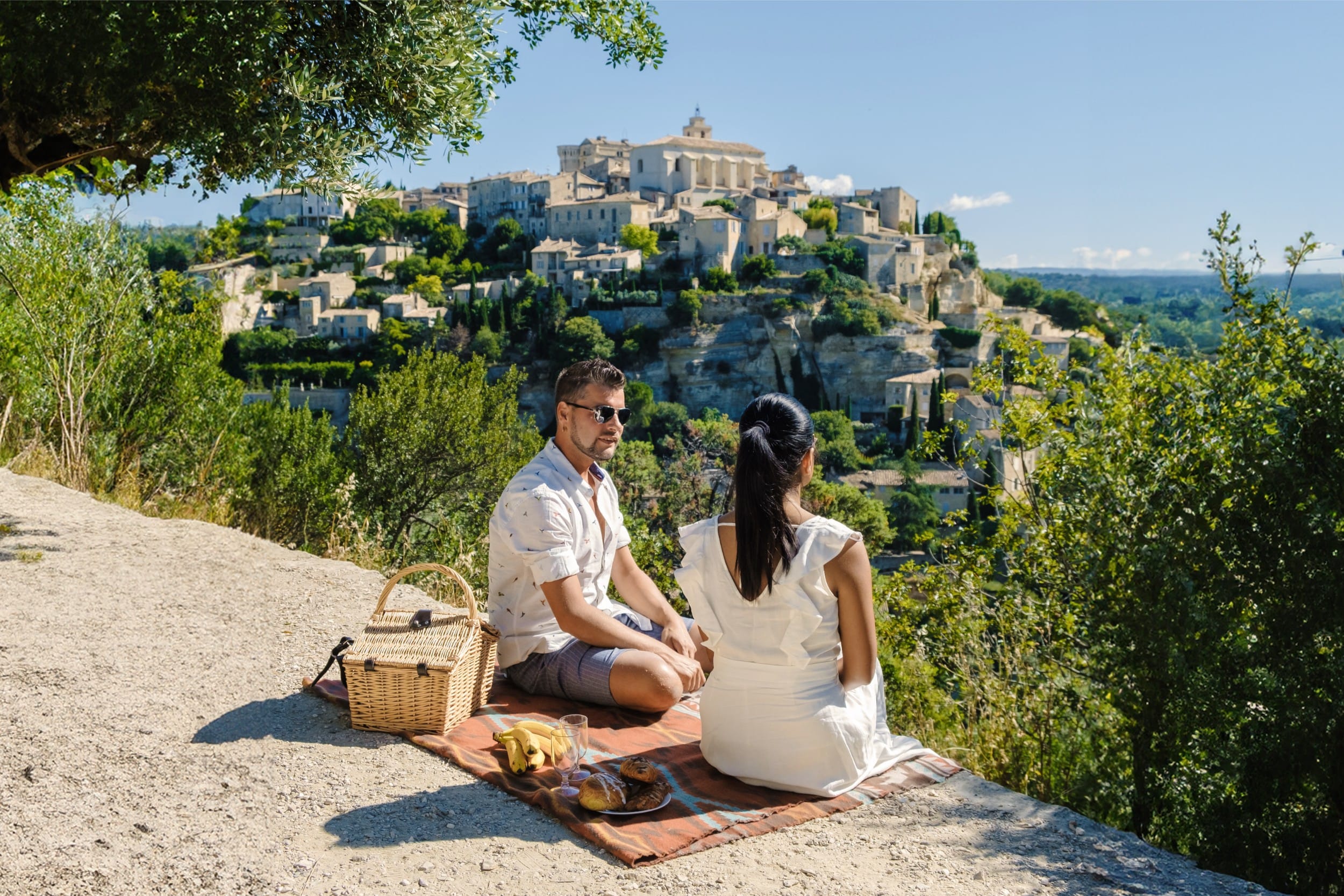
The beauty of southern castles changes radically with the season. In spring, the light is already clear but less overwhelming, and the landscapes (garrigues, vineyards, meadows) are greener. Autumn often offers a sumptuous atmosphere: deep skies, warm colors, ideal temperatures for long walks on exposed sites like Peyrepertuse. In summer, attendance increases and the heat can be harsh, but evenings, shows, and cultural events also give a particular energy to certain places.
To better manage the crowds, aim for opening hours, or conversely the late afternoon. And if your stay includes the coast, choose heritage days inland when the coast is the busiest. This also applies to excursions around very popular destinations: planning intelligently allows for considerable comfort, as suggested by these tips for enjoying a more serene day in Saint-Tropez before or after a heritage visit in the hinterland.
Between visits and the art of living: gastronomy, markets, and local tables
Visiting a castle in the south is rarely an isolated experience: you pass through villages, stop at a market, taste a product, and chat with a craftsman. What makes these trips so enjoyable is the opportunity to connect the stones to what still nourishes the territory. After a morning on the ramparts, a simple lunch — olive oil, tapenade, sun vegetables, cheeses, fish or lamb depending on the region — becomes a natural extension of the visit.
To create meals that speak of the place as much as the castle itself, you can draw ideas from a panorama of Provençal specialties not to be missed.. Even if you travel beyond Provence, this approach (favoring local, seasonal, and regional recipes) works everywhere in the south and transforms a simple itinerary into a true immersion.
Festivals, sounds, and lights: when castles become stages
Many castles in the south host events: concerts, theater, screenings, reenactments, night visits. This type of programming changes the perception of places: the night blurs details, accentuates volumes, and the staging awakens the imagination. Attending a performance in a courtyard or at the foot of a rampart is to feel the strength of heritage differently, in a more sensitive than educational atmosphere.
If you are staying in Var or passing through the region, spotting key dates can make all the difference. To complete your agenda, you can consult a selection of must-see events and schedule your castle visits around a concert, a local festival, or a gastronomic evening.
Need a room? Book directly!
Practical tips for successful (and more comfortable) visits
A castle in the south is often visited in the sun, on cobblestones, uneven steps, and sloping paths. The essentials: stable shoes, plenty of water, a hat, and some time margin to avoid turning the visit into a race. For cliff sites, check the weather: the wind can be strong and the feeling of coolness deceptive, while the heat can make the ascent more challenging than it appears.
On the organization side, it's better to choose one or two major visits per day and keep free slots for unexpected events: a viewpoint, a market, a swim, a detour through a village. The castles are beautiful, but it’s the transitions — the cypress-lined road, the shaded terrace, the unexpected panorama — that give the journey its texture.
Where to stay to easily radiate: relaxation, spa, and gastronomy
To fully enjoy the castles, the ideal is to settle in a central base, then radiate outwards. This avoids repacking every day and allows for real rest, especially after physical visits. Many travelers also appreciate balancing a day of stones and panoramas with a moment of relaxation, such as a spa, a nice meal, or simply a quiet evening.
If you are looking for a stay idea that combines rest and culinary pleasures, here is a suggestion for a well-being and gourmet break that perfectly matches a program of heritage visits in the south.
Conclusion: choosing your castle is choosing an emotion
There is not just one type of castle in the south, but a collection of experiences. Some sites impress with military power, others touch with the elegance of a facade or the softness of a landscape. There are castles for those who love heights and walking, castles for history enthusiasts, and castles for those who mainly want light, gardens, and sea air. The most beautiful, in the end, is the one that resonates with your way of traveling: contemplative, sporty, gourmet, curious.
And to prepare your stay without complications, you can go directly through Need a room? Book directly!